
Exhibit Rental Pricing Guide: 2026 Costs, Fees & Budgeting

Exhibit rental pricing is set by four inputs: booth size and configuration, the labor rules of the show city, the level of customization, and your show calendar. The rental quote covers the exhibit itself, while material handling, electrical, rigging, and show-floor labor arrive on separate invoices from the show contractor. For a marketing leader running several shows a year, that gap repeats at every stop, and an incorrect rent-or-own decision compounds these extra costs across your annual calendar.
I’m Loren Gundersen, owner of Art & Display in Santa Cruz, California. Our team brings over 75 years of combined experience to designing and building custom, modular, and rental exhibits, producing custom millwork and large-format graphics in-house, while managing every project from concept through dismantle.
The key is understanding what factors shape the rental quote and which costs are billed separately. This guide covers the drivers behind custom exhibit rental pricing, what a turnkey quote includes, separate show fees, when renting beats owning a custom trade show display, how a hybrid program combines both, and essential questions to ask before signing. For purchase pricing, see our display cost guide.
1. What Drives Exhibit Rental Pricing
- Booth size and configuration: square footage sets the baseline. Island displays and peninsula spaces require more structure, graphics, and labor than inline spaces, while large-format builds require additional structural engineering.
- Location and venue rules: labor rules differ by city and venue, and some convention centers require union crews for assembly. That raises installation and dismantling (I&D) costs in those markets.
- Customization: custom graphics, backlit fabric, dimensional logos, and integrated audio-visual equipment all add to the base rental price.
- Show schedule: back-to-back shows in different cities change freight and labor planning, so share your full calendar with your rental partner up front.
Location deserves the most attention of the four, because the spread between cities keeps widening. The Exhibitor Advocate, a nonprofit association for exhibit marketers, reports in its 2025 Annual Survey of Exhibition Rates that exhibiting in New York costs approximately 75 percent more than exhibiting in Atlanta for the same basket of services.
The same survey found material handling base rates up 21.3 percent since 2022 and electrical outlet rates up 18.4 percent in 2025 alone. While a rental quote remains fairly consistent across cities, associated venue and contractor invoices will vary significantly.
2. What a Turnkey Exhibit Rental Includes
A turnkey rental bundles components you would otherwise need to source from separate vendors. Confirm that each quote covers the following:
- Rental hardware and structure
- Custom graphics printed for your show
- Flooring and furniture, such as reception counters and demo stations
- Installation and dismantle labor
- Project management from design approval through show close
Graphics carry most of the branding impact in a rental. With high-quality components and custom graphics, a rental exhibit can look fully custom on the show floor. Larger footprints also accommodate dedicated meeting spaces, demo zones, and a comfortable traffic flow for attendees.

How to Make a Rental Read as Custom
Today’s rental systems give you a wide design range. Most are built on aluminum frames and extrusions that reconfigure into many layouts, and custom graphics give each configuration its own look. A few ways to push a rental further:
- Mix in purchased pieces: a custom counter, backlit panels, or a branded conference room can sit inside rented framing, so you pay for the signature elements and rent the structure around them.
- Choose the right surfaces: silicone edge graphics, rigid panels, wood, and colored acrylic can all clad or cover a rental frame.
- Add dimension: logos cut from rigid materials and mounted on standoffs give flat walls depth.
Rentals have limits worth knowing. Rental components must be returned in their original condition. If your design requires extensive structural modifications or custom-colored extrusions to meet brand standards, purchasing a custom trade show display is usually the better fit.
Which Design Choices Move the Rental Price Most
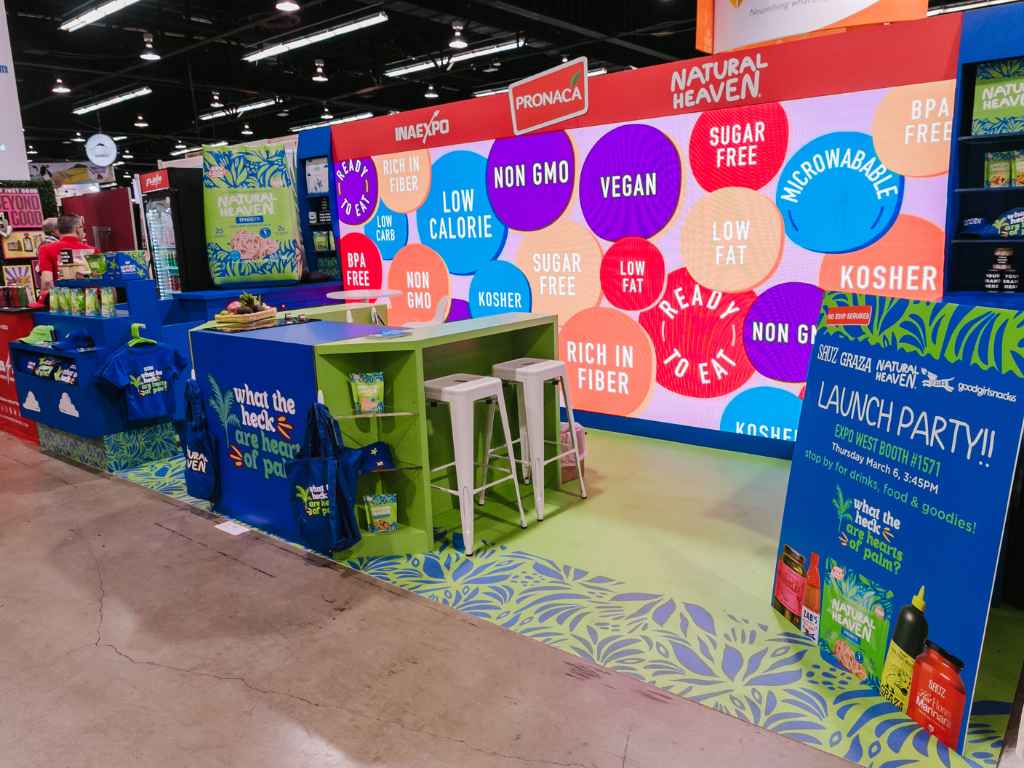
Customization appears as a single line item in most quotes, so it helps to know which options within that category carry the highest cost. At Art & Display, the design features that add the most to a rental quote are overhead hanging signs, backlit fabric, and LED walls. Overhead hanging signs add rigging labor and require advance orders with the venue. Backlit fabric costs more than standard printed fabric due to the necessary lighting hardware and power integration. LED walls add both equipment and integration time.
Each of these choices earns its place in an island program when it serves a specific goal for the show. Ask your rental partner to price the signature elements separately so you can evaluate their individual cost impact and allocate your budget effectively.
3. Show Costs Billed Outside the Rental Quote
The rental price and the total show investment are distinct numbers. These third-party charges usually originate from the show’s general service contractor or venue and arrive on separate invoices:
- Material handling (drayage): the fee for moving your freight from the dock to your space and back, billed by weight per hundred pounds.
- Union labor: where venue rules require it, union crews handle assembly, and rates vary by city. Review the trade show union rules for each show on your calendar.
- Electrical and rigging: power drops and overhead signs need advance orders and specialized labor.
- Internet and lead retrieval: connectivity and lead capture tools carry their own service fees.
Freight weight and delivery deadlines directly affect these costs. Lighter crates, consolidated shipments, and on-time arrival at the advance warehouse keep material handling charges manageable. Ask your rental partner how they pack and ship to keep these charges down.
Keep Material Handling Charges in Check
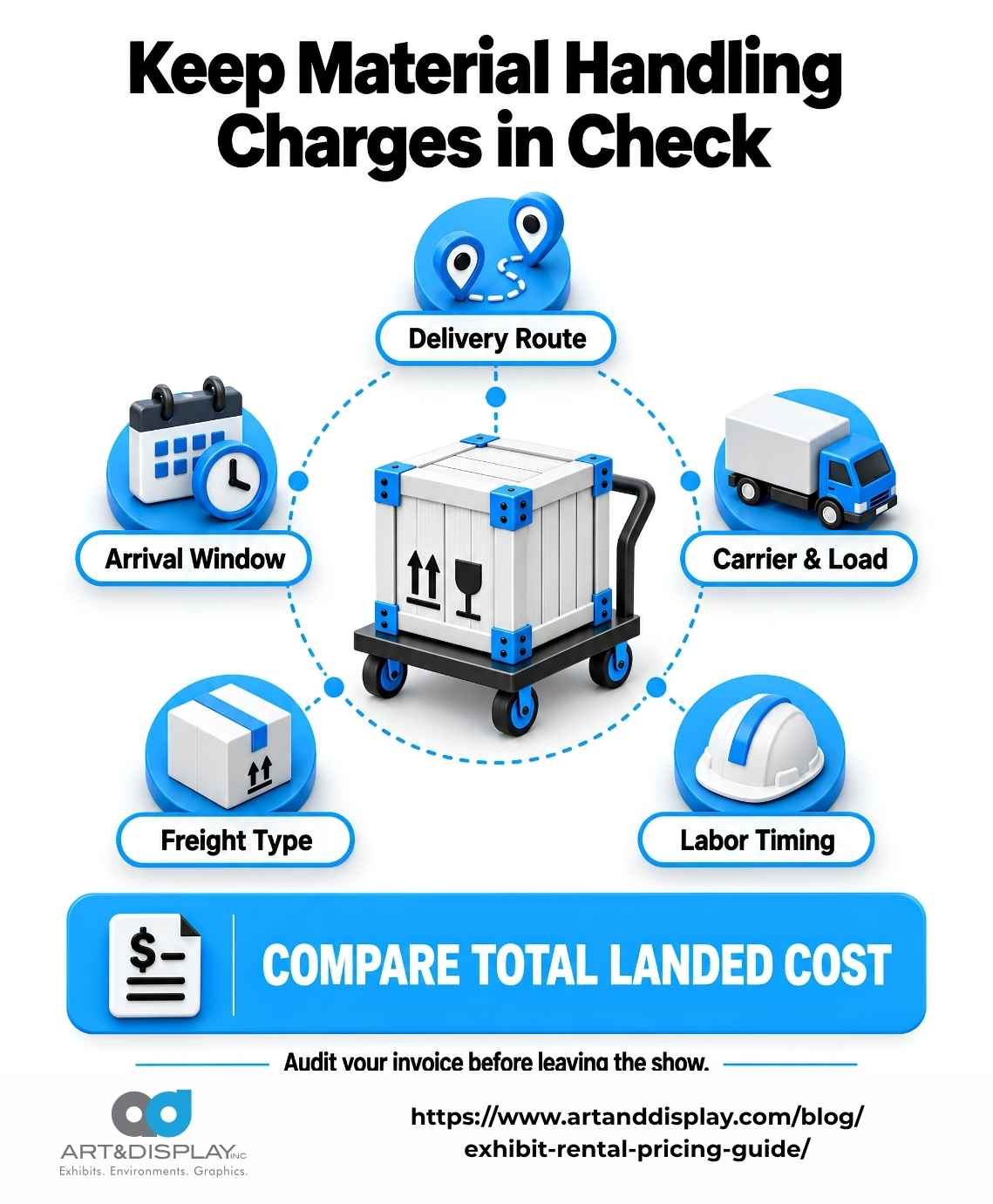
Material handling is often the hardest line on the show invoice to predict. The rate changes with factors you can plan around:
- Whether freight goes to the advance warehouse or directly to the show site
- Whether it arrives inside the delivery window listed in the exhibitor services manual
- The type of carrier and how the truck is loaded
- Whether the freight is crated, uncrated, or needs special handling
- Whether it is unloaded or reloaded on overtime
When evaluating rental quotes, compare the total landed cost, with estimated material handling included, alongside the rental price. Then audit the material handling invoice while your team is still on site, because charges are far easier to correct while the service desk is open.
Art & Display advises every client to perform three on-site audits: verify certified weight tickets against what shipped, confirm which hours were billed at overtime, and question any special handling flag you did not request.
4. Renting vs. Owning: How to Run the Math
A common rule of thumb says that once you use the same exhibit more than three times, buying becomes more cost-effective than renting. Treat that number as a starting point. Ownership introduces recurring costs beyond the initial purchase price:
- Storage between shows
- Maintenance, repair, and refurbishment
- Property insurance required for owned assets
- Depreciation over the exhibit’s useful life
Involve your finance team early. An owned exhibit is a capital expenditure depreciated over time, and a rental is an operating expense. Your finance team will have a preference between the two, so raise the question at the planning stage. Renting also keeps capital free for attendee-facing elements like custom graphics, interactive demos, and technology.
Whichever option you choose, measure performance as cost per show and tie it directly to pipeline generation. Those two numbers together let leadership measure trade show returns at budget time, and they turn the rent-versus-own question into a comparison of cost per qualified lead across the calendar.
When Renting Tends to Win
- Shows cluster in the same weeks across distant cities
- Your footprint changes from show to show
- You are entering a new market or adding a new show to the calendar
- Messaging changes by audience, so one rented design with several sets of custom graphics covers the calendar
When Owning Tends to Win
- The same footprint and messaging repeat across most of the calendar
- Your brand standards call for custom finishes throughout
- The exhibit anchors your flagship shows year after year
5. The Hybrid Model: Own the Core, Rent the Rest
Many multi-show programs own a core set of branded assets, such as a signature reception counter, backlit wall, or private conference room, and rent the surrounding structure. Owned elements maintain brand consistency across events, while rented components let you scale your footprint up or down per show.
A hybrid model is also useful during show clusters. If two events occur during the same week or on opposite coasts, deploy your owned exhibit at the anchor show and a rental matching your brand standards at the second location.
Reusing modular components across shows also cuts material waste, which is a core practice in sustainable exhibit construction. If your company reports on environmental, social, and governance goals, build reuse into the brief from the start, and ask your rental partner which components carry over between shows.
6. Lead Time, Rush Orders, and Rental Price
Lead time is the one cost driver that a marketing team controls completely. A custom rental at Art & Display typically spans six to eight weeks from concept to deployment, which covers discovery, design and approval, graphic production, pre-assembly, and shipping. Within that timeframe, the quote remains standard.
If the schedule is compressed, rush charges will apply to graphic production and freight. Missing advance-order deadlines for electrical and rigging services also forces those items to be billed at higher floor rates.
Request the rental quote as soon as the booth space is confirmed, and share the entire annual calendar at that point. A partner who can see the full year can plan freight routes, hold components for back-to-back shows, and schedule graphic refreshes at production rates.
7. What Happens Between Shows in a Rental Program
A rental program running across a multi-show calendar requires ongoing management between events, which directly impacts total costs. After each show, the rental partner dismantles the structure and adapts the configuration for the next footprint. Graphics are the main carryover question.
A program that reuses panels across events, refreshing only the messaging that changes, spends less on reprints than one that starts over each time. Art & Display rental clients keep their custom graphics after each show, and Art & Display stores them between events. When only part of the messaging changes, Art & Display offers a partial refresh at a lower rate than a full reprint.
8. Questions to Ask Before Signing a Rental Quote
A detailed quote protects your budget, and the right questions surface costs while they can still be negotiated. Ask every rental partner:
- What does the quote include, and which costs will they show billed separately?
- Do we keep the custom graphics after the show, who stores them between events, and is a partial refresh priced lower than a full reprint?
- What condition do rental components need to be in when they come back, and how are damages handled?
- Where will the rental ship from, and do you have facilities or partners near our show cities?
- Who supervises installation and dismantling on site?
- What are the deadlines for graphics files and design changes?
- Can you price the signature design elements as separate line items?
Written answers to these questions give you a quote you can defend to finance and a plan your team can run at every stop.
Frequently Asked Questions About Exhibit Rental Pricing
How Much Does It Cost to Rent a Trade Show Exhibit?
Renting a trade show booth from Art & Display costs roughly one-third to one-half of buying the equivalent exhibit. The final number depends on booth size, design complexity, the labor rules of the show city, and the length of the rental program. A quote for a 20×20 island or larger reflects the added structure, graphics, and labor that footprint needs.
Is Material Handling Included in an Exhibit Rental Quote?
Material handling is billed by the show’s general service contractor, so it appears on the show invoice, separate from the rental quote. Ask your rental partner for an estimate based on crate weight so you can accurately evaluate your total projected spend.
How Far in Advance Should I Request a Rental Quote?
Request the quote as soon as the booth space is confirmed. A custom rental typically needs six to eight weeks from concept to deployment, and the venue’s advance-order deadlines for electrical and rigging usually fall inside that window.
Key Takeaways
- The rental quote covers the exhibit, and material handling, union labor, electrical, and rigging usually arrive on the show’s own invoices.
- Booth size, venue labor rules, customization, and your show schedule move exhibit rental pricing the most.
- After roughly three uses of the same design, purchasing often becomes the better value once storage, maintenance, insurance, and depreciation are counted.
- Owning signature branding pieces while renting the structure keeps brand consistency and footprint flexibility.
- Sharing your full annual show schedule up front lets rental partners plan freight, labor, and graphic refreshes across every event.
Plan Your Next Exhibit Rental With Art & Display
When your exhibit shines, your whole strategy gets the credit. Art & Display designs custom exhibit rentals built to your brand standards, complete with setup, logistics coordination, and on-site support—managing every project from initial concept through dismantle. You handle the strategy. We’ll handle the exhibit that makes everyone say, “You nailed it.” Contact Art & Display to schedule a free consultation.
Let’s Build Something Great Together.